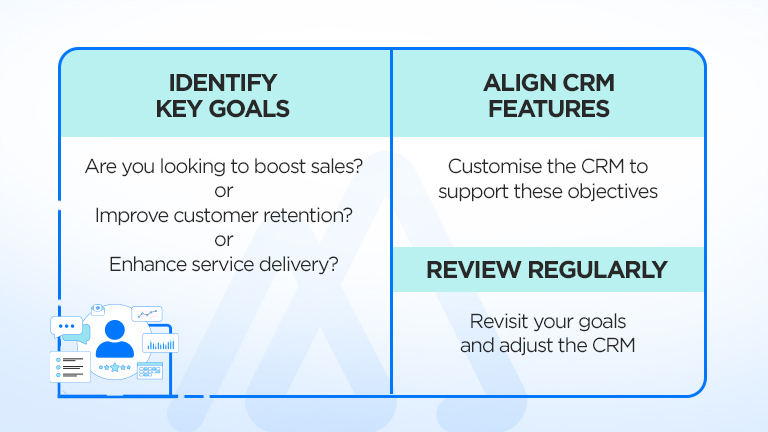
In an increasingly competitive, data-driven world, a company’s ability to grow and adapt hinges on how well it can align its business goals with its CRM strategy. Too often, organizations invest in Customer Relationship Management (CRM) systems without a clear understanding of how they support broader objectives. The result? Underused technology, scattered customer data, and misaligned efforts across departments.
When CRM strategy is purposefully built to support business goals—from revenue growth and customer retention to operational efficiency and digital transformation—the platform evolves from a simple tool into a strategic powerhouse.
In this comprehensive article, we’ll explore how to align CRM strategy with key business goals, ensuring your organization extracts maximum ROI from your CRM investment.
What Does It Mean to Align CRM Strategy with Business Goals?
CRM strategy alignment means designing your CRM’s structure, processes, and functionalities to directly support your business’s strategic objectives. Instead of merely using the CRM as a contact database, businesses must configure and use it in ways that:
- Increase revenue
- Improve customer experience
- Streamline internal processes
- Provide actionable insights
- Enhance cross-functional collaboration
It’s about making sure that every CRM feature, workflow, and report contributes to achieving your highest priorities.
Why Misalignment Costs You More Than You Think
A misaligned CRM strategy leads to:
- Low user adoption
- Siloed or inaccurate customer data
- Inconsistent customer experience
- Missed revenue opportunities
- Ineffective campaigns and poor sales forecasting
A CRM that isn’t tied to real goals becomes a cost center rather than a growth enabler. Conversely, when aligned, CRM becomes a mission-critical system for executing strategic plans.
Step-by-Step Guide to Aligning CRM Strategy with Business Goals
1. Start with Your Core Business Objectives
Before configuring a single CRM workflow, you need clarity on your business goals. These might include:
- Increase revenue by 25% in 12 months
- Reduce customer churn by 15%
- Improve sales pipeline visibility
- Launch new products in a target market
- Accelerate lead response time
Your CRM strategy should be mapped to specific, measurable goals. This ensures all CRM activities are working in service of your strategic vision.
2. Identify Key Stakeholders Across Departments
CRM isn’t just for sales—it affects marketing, customer service, operations, finance, and even product teams. Gather input from all relevant stakeholders to understand:
- What customer data they need
- What processes can be automated
- What insights drive better decisions
- What pain points exist today
This cross-functional approach ensures that CRM becomes a unifying platform rather than a siloed tool.
3. Define KPIs and Metrics That Matter
Once you’ve linked business objectives with CRM usage, define the Key Performance Indicators (KPIs) you’ll track to measure success. Examples include:
- Sales KPIs: lead-to-close rate, average deal size, pipeline velocity
- Marketing KPIs: lead source ROI, email engagement rates, MQL conversion
- Service KPIs: first response time, CSAT scores, ticket resolution speed
These metrics should be visible via CRM dashboards, ensuring real-time visibility and alignment at all levels.
4. Design CRM Workflows That Support Business Processes
Your workflows should mirror your operational structure while supporting your goals. Some examples:
- Automating lead assignment to reduce response time
- Triggering customer onboarding emails after a deal closes
- Flagging deals that stall beyond a certain time period
- Segmenting customers for upsell campaigns based on purchase history
Each workflow must serve a purpose tied to a business outcome, not just system automation for its own sake.
5. Leverage CRM Features Strategically
Modern CRMs offer a host of features—pipeline management, automation, email integration, AI insights, reporting, custom objects—but using all of them without a goal will lead to complexity.
Use features selectively, based on strategic needs:
- Need to improve forecasting? → Use deal stage analytics
- Need to reduce churn? → Use customer health scoring and automated follow-ups
- Need to scale personalization? → Use segmentation and email workflows
Align features to solve real business problems, not just to fill the tech stack.
6. Train Teams on Goal-Oriented CRM Usage
Even the best CRM setup fails without user adoption. Train each department not just on “how” to use the CRM, but on “why” it matters to the business’s success.
Provide clear documentation, regular refreshers, and success stories showing how CRM use leads to:
- Closed deals
- Happier customers
- Improved productivity
- Performance recognition
Tie CRM activity directly to team and individual goals to create motivation and accountability.
7. Regularly Review and Optimize Based on Outcomes
Alignment is not a one-time task. Business goals evolve, and so should your CRM.
- Review CRM dashboards monthly or quarterly
- Meet with stakeholders regularly to assess performance gaps
- Optimize workflows, fields, and automations based on what’s working
- Deactivate unused features and streamline for clarity
This ensures your CRM strategy stays dynamic and keeps pace with your business growth.
Real-World Examples of Goal-Aligned CRM Strategy
Case 1: B2B SaaS Company – Goal: Increase Free Trial Conversions
CRM Solution:
- Triggered onboarding emails post-sign-up
- Assigned leads to reps based on territory
- Tracked feature usage via CRM integrations
- Flagged disengaged users for follow-up
Outcome: 32% increase in trial-to-paid conversion rate in 3 months.
Case 2: eCommerce Brand – Goal: Improve Repeat Purchases
CRM Solution:
- Segmented customers by purchase history
- Sent automated reorder reminders
- Offered loyalty points through CRM-integrated programs
Outcome: Repeat purchase rate increased by 18% within 90 days.
Case 3: Financial Services Firm – Goal: Enhance Compliance Tracking
CRM Solution:
- Custom fields for regulatory status
- Document logging and audit trails
- Task reminders for license renewals and document expiry
Outcome: Reduced compliance breaches to zero over a year.
Best Practices for Sustained CRM Alignment
- Start small, then scale: Begin with a single department or goal
- Use CRM reports to inform strategy: Let data lead decision-making
- Get executive buy-in: Leadership support drives adoption
- Limit customization to what’s necessary: Keep your CRM lean and purposeful
- Review CRM goals quarterly: Align them with business planning cycles
Conclusion: CRM Strategy Should Drive Your Business Forward
A CRM system should never exist in isolation. Its true power lies in how well it supports the vision, goals, and growth path of your business. By aligning your CRM strategy with specific business objectives, you transform it from a system of record into a system of revenue, retention, and results.